For many small towns and local communities, managing municipal services comes with a constant challenge: how do you cover all necessary activities with a limited budget?
Street cleaning, snow removal, green space maintenance, and occasional interventions are all essential—but each requires equipment, operators, and ongoing costs.
In this context, more and more local administrations are looking for efficient alternatives, and Multihog multi-functional machines are increasingly becoming part of that conversation.
The context: limited budget, multiple needs
Let’s consider a typical small town or community with:
- 8,000 – 15,000 residents
- local roads and secondary streets
- public green spaces (parks, roadside areas)
- responsibilities for sanitation and maintenance
The annual budget allocated for equipment is limited, and investments need to be carefully justified. Traditionally, this would mean acquiring multiple dedicated machines, each designed for a specific task.
At this point, a key question arises: is there a more efficient solution than maintaining a fragmented fleet?
The problem: high investment, low utilization
The traditional approach often leads to the same set of challenges:
- expensive equipment used only seasonally
- maintenance costs for each individual machine
- difficulty justifying long-term investments
- limited flexibility in day-to-day operations
For small communities, these inefficiencies quickly become visible—both financially and operationally.
The alternative approach: one Multihog machine, multiple applications
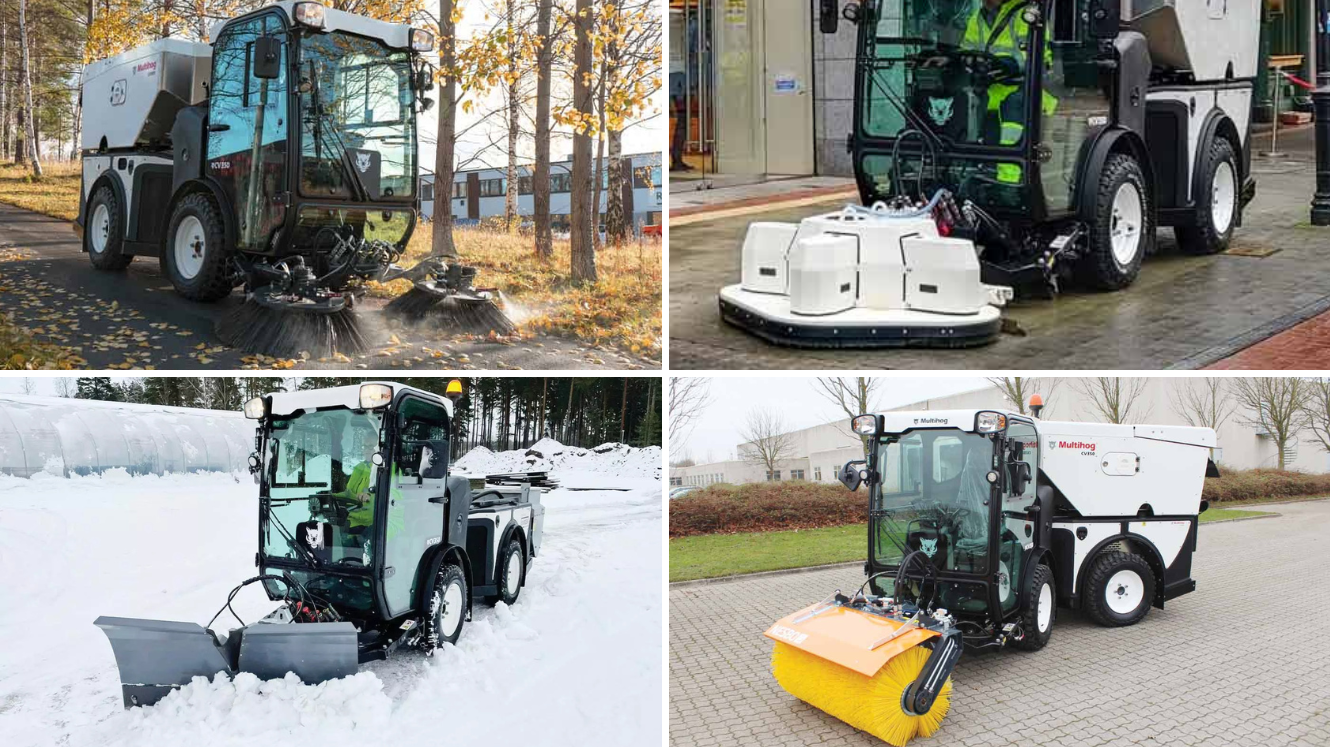
Instead of relying on a fleet of specialized machines, a local administration can opt for a Multihog multi-functional machine, equipped with attachments tailored to its specific needs.
The Multihog platform is designed exactly for this type of scenario: one machine that can be used year-round, simply by switching attachments quickly and efficiently.
Over the course of a year, a single Multihog machine can handle:
- winter: snow clearing and de-icing
- spring: street cleaning and debris removal
- summer: green space maintenance and mowing
- autumn: leaf collection and general cleaning
This means the machine is no longer tied to a single role, but becomes an active asset throughout the entire year.
The result: operational efficiency and optimized costs
By implementing a Multihog multi-functional solution, the impact becomes clear in a relatively short time.
Instead of managing multiple pieces of equipment, the local administration benefits from:
- reduced total initial investment
- lower maintenance costs
- continuous utilization of the Multihog machine
- simplified planning and operations
At the same time, field teams can work more efficiently, without depending on multiple specialized units.
Why Multihog works for small towns and communities
For smaller municipalities, the main challenge is not necessarily the volume of work, but the diversity of tasks throughout the year. This is where the versatility of the Multihog platform becomes a real advantage.
With a wide range of available attachments, a Multihog machine can replace several dedicated units without compromising performance.
The result is a smarter use of resources and a better alignment with real operational needs.
Conclusion
For a small town or local community with a limited budget, choosing the right equipment can make the difference between ongoing financial pressure and efficient resource management.
A Multihog multi-functional machine doesn’t just solve a single problem—it introduces a more efficient way of organizing municipal services: simpler, more flexible, and more cost-effective.
If you’d like to explore how a Multihog machine can be configured for your specific needs or which attachments would best fit your operations, our team can provide a tailored recommendation.