In a modern energy system, the challenge is no longer only about producing energy. Just as important is how that energy is managed, stored and used at the right moment.
This becomes especially relevant in industrial applications, where consumption can vary, power continuity is essential, and all available energy sources need to be coordinated efficiently.
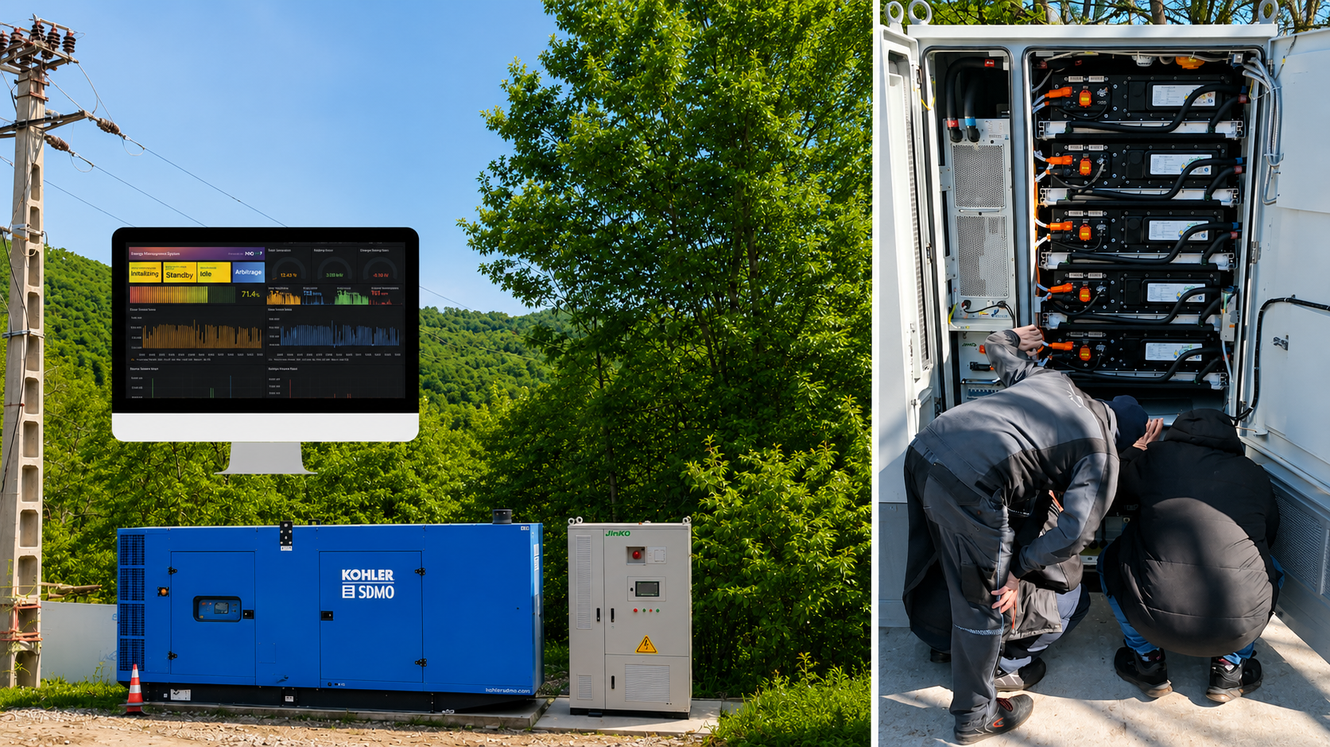
A concrete example is the integration of a Jinko Sungiga G1 energy storage system, with a capacity of 100 kW / 215 kWh, together with PowerKonnekt EMS, in an application that includes 5 photovoltaic parks and a backup generator with ATS.
Why PV production alone is not enough
Photovoltaic systems are an excellent solution for reducing energy costs and increasing energy independence. However, solar energy has one important characteristic: production is not constant.
It depends on the time of day, weather conditions and the consumption profile of the site. At certain moments, production can be higher than consumption. At others, consumption can exceed the available PV production.
This is where the energy storage system becomes essential.
The battery allows locally produced surplus energy to be stored and used when needed. As a result, energy is no longer treated only as a resource available in real time, but as one that can be managed strategically.
The role of the energy storage system
In this application, the Jinko Sungiga G1 storage system is not only used to store energy. It becomes an active component in balancing the entire installation.
Through energy storage, the system can contribute to:
- increasing self-consumption from photovoltaic sources;
- reducing inefficient energy use;
- supporting consumption when PV production is lower;
- reducing the demand placed on the backup generator;
- improving the flexibility of the entire energy system.
In other words, the battery is not just a backup solution. It is a component that helps the system respond more intelligently to the variations between production and consumption.
The EMS: the component that makes the difference
If the battery stores the energy, the EMS decides how that energy should be used.
PowerKonnekt EMS coordinates the energy flows between the photovoltaic parks, the storage system, the consumers and the generator. Its role is to analyze energy availability, battery state of charge, consumption demand and the operating conditions of the system.
Based on this information, the EMS decides how the available energy should be managed.
For example, photovoltaic energy can be directed to consumers, used to charge the battery or managed according to the priorities of the application. When needed, the battery can support consumption, while the generator can step in to ensure continuity and safety.
Without a properly integrated EMS, each component would operate more or less independently. With an EMS, all equipment works as part of the same coordinated system.
The backup generator remains important
In a project like this, the generator does not disappear from the equation. On the contrary, its role becomes better defined.
The backup generator ensures power continuity when the system requires an additional source or when operating conditions demand it. The difference is that, through integration with the battery and the EMS, the generator can be used more efficiently.
Instead of running unnecessarily or at the wrong time, it can start in a controlled way, based on the real needs of the application.
In this particular project, the generator also has its own story: it was supplied and installed by the Best Tools team a few years ago. Today, it is part of a more complex energy architecture, together with PV production, storage and intelligent energy management.
The real challenge: integration
At first glance, a project like this may seem to be mainly about equipment: batteries, photovoltaic systems, generators, panels and automation.
In reality, the essential part is integration.
In this application, the system had to coordinate 5 photovoltaic parks, one energy storage system, a backup generator with ATS and the existing consumers, all across a site of approximately 10 hectares.
This requires communication between equipment, synchronization, correct configuration and an operating logic adapted to the real needs of the beneficiary.
A high-performing energy system is not only about good components. It is about components that communicate well with each other.
The result
By integrating the Jinko Sungiga G1 energy storage system and PowerKonnekt EMS, the application benefits from better control over locally produced energy, more efficient use of available sources and increased operational stability.
Photovoltaic energy can be used more intelligently. The battery can support consumption when needed. The generator remains available for safety and continuity. And the EMS coordinates the entire system.
This is the direction in which industrial energy systems are evolving: not only production, not only backup, not only storage, but the intelligent integration of all available energy sources.
For applications where continuity, efficiency and energy control are important, the combination of PV, BESS, generator and EMS is becoming an increasingly relevant solution.