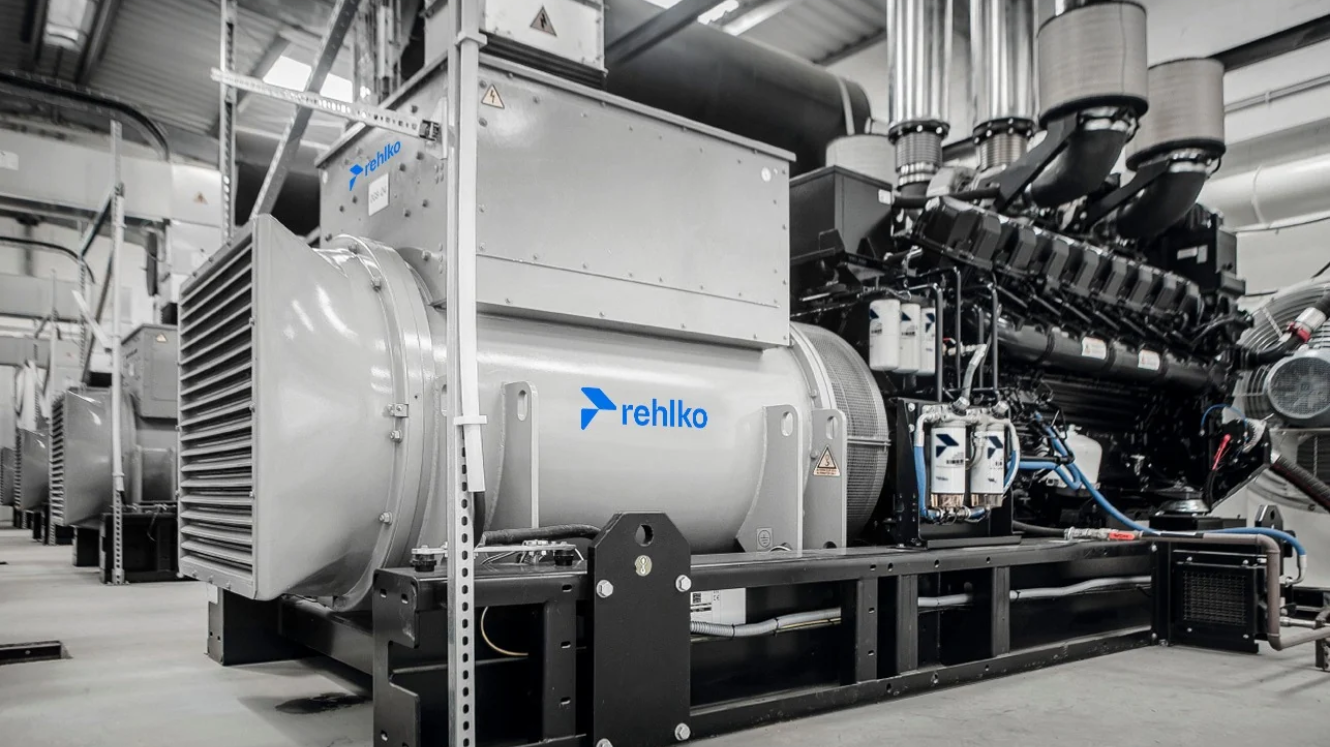
A facility’s power requirements can change as it develops and even throughout the day. Expanding a production hall, installing new equipment or introducing stricter continuity requirements can all influence the design of its backup power system.
Operating multiple generators in parallel can provide greater operational flexibility, room for future expansion and additional redundancy. These benefits depend on correct sizing and on how the generators are integrated and controlled.
What does generator paralleling mean?
In a paralleled system, two or more generator sets are connected to a common electrical system and work together to supply the loads. The load is shared between generators, with their operation coordinated through automation and control equipment.
Before connecting in parallel, the generators must be synchronized. This process involves matching electrical parameters such as voltage, frequency and phase within the conditions required for connection. Once connected, the control system manages load sharing between the operating units.
Synchronization can take place between generators or, in specifically designed configurations, between generators and the utility grid. This article focuses on multiple generators operating together.
Matching capacity to power demand
A facility does not require the same amount of power at all times. Some equipment operates only during certain periods, production processes can vary, and loads may be connected or disconnected in sequence.
In a system equipped with automatic load management, the number of operating generators can be adjusted to demand. Additional units can be brought online as consumption increases. When demand falls, some generators can be stopped within the limits defined by the system design and while maintaining the required reserve capacity.
This flexibility allows the installed capacity to be used according to actual operating conditions.
Redundancy for greater availability
For applications where a power interruption can have significant consequences, reserve capacity can be an essential design consideration.
A redundant configuration allows the system to support its designated load even when one unit is unavailable. One example is an N+1 configuration: “N” represents the number of generators needed to supply the design load, while “+1” represents an additional unit.
However, connecting two generators in parallel does not automatically make a system redundant. If both are required to meet the full demand, taking one offline reduces the available capacity below the required level. Redundancy must be established through proper sizing, taking priority loads and system behaviour during an outage into account.
Greater flexibility for maintenance
Regular servicing and inspections are necessary to keep generators ready for operation. In a system with multiple units and sufficient reserve capacity, maintenance can be scheduled one generator at a time.
One generator can therefore be temporarily taken out of service while the others remain available to support the designated load. This provides greater flexibility when planning maintenance and reduces the impact of an individual unit being unavailable.
Whether maintenance can be carried out under these conditions depends on the entire installation, including switchgear, protection systems and the ability to isolate equipment.
Opportunities to improve fuel efficiency
Generator paralleling can also contribute to more efficient fuel use. By adjusting the number of active generators, the load can be distributed so that the operating units run within a suitable loading range.
This benefit is particularly relevant when power demand varies significantly and operating hours are sufficient for those differences to affect overall performance.
Fuel savings are not automatic, however. They depend on the load profile, generator characteristics, operating hours and control strategy. The potential benefits must be assessed for each application.
Expanding capacity in stages
An installation designed for future expansion can allow additional generators to be integrated as power requirements grow.
This approach can be useful for industrial facilities, logistics centres or data centres developed in phases. Generating capacity can grow alongside the project, with investment aligned to the commissioning of new loads.
To make this possible, future expansion must be considered from the outset. Switchgear, controls, electrical connections, available space and supporting infrastructure must be able to accommodate the future configuration. Adding further units also requires their compatibility with the existing system to be verified.
When should a paralleled system be considered?
Paralleled generators can be an option for projects with high or variable power demand, redundancy requirements or plans for expansion. Selecting a configuration starts with a few key questions:
- What load needs to be supplied, and how does it vary?
- Which loads must be given priority?
- How much reserve capacity is required?
- How will maintenance and servicing be organised?
- What expansion is planned over the medium and long term?
The answers help determine the number and rating of the generators, as well as how they will be controlled. A multi-generator configuration also requires additional integration equipment, so its benefits should be assessed alongside the technical requirements and costs of the complete system.
From power requirements to an integrated system
The performance of a paralleled generator installation depends on correct sizing, controls, protection and the proper integration of all components.
Best Tools Company, an official Rehlko distributor in Romania, provides support from consultation and sizing through to integration, commissioning and maintenance, with nationwide service coverage.
Whether you are developing a new project or expanding an existing installation, our team can assess the application’s requirements and help define a suitable power supply configuration.