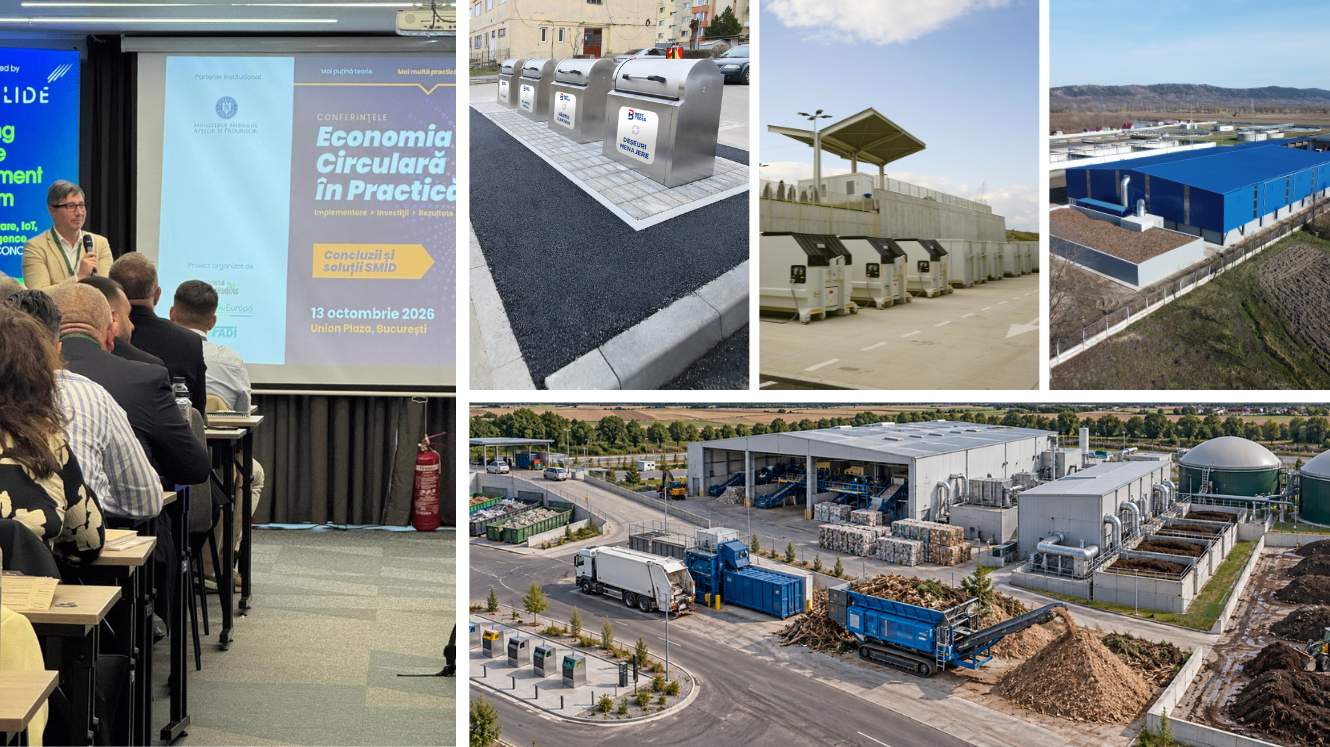
On 13 October 2026, we took part as speakers in the “Circular Economy in Practice – Implementation | Investments | Results” conference, held at Union Plaza in Bucharest. The event addressed a key question for waste management: how to connect investment, infrastructure and practical experience to deliver results for communities.
For Best Tools Company, the emphasis was on “in practice”. We shared examples of projects we have implemented and those currently underway in Romania, exploring the connections between waste collection, transport, sorting and treatment. These projects have different requirements but share a common need: every piece of equipment and every stage must contribute to the performance of the overall system.
From separate collection to processing infrastructure
Our waste management experience covers several stages of this process. At the collection stage, we have helped develop infrastructure through smart waste collection points, containers for different waste streams and separate collection equipment. These solutions bring collection facilities closer to residents and help organise waste streams at source.
Voluntary waste collection centres (CAVs) are another important component. We have been involved in equipping more than 140 standard centres nationwide, as well as larger facilities with more complex functions. These include the large centre in Cluj-Napoca, which we equipped, and the Brașov project, currently under implementation. At such centres, collection is complemented by infrastructure for sorting and processing selected waste streams, depending on the project’s configuration.
Refuse collection vehicles, container transport systems and transfer stations provide the link to the next stages. Their selection and sizing influence how waste moves from collection points to the facilities equipped to receive it.
Further along the process, our projects include sorting facilities, mechanical and biological treatment plants, and composting solutions. One example is the sludge composting plant in Câmpia Turzii, which incorporates a biofilter for air treatment. Alongside green waste composting solutions, these investments address waste streams that require dedicated infrastructure and processes.
Equipment must work as part of an integrated system
A central point of our presentation was the relationship between these stages. Separate collection must be coordinated with transport capabilities, while sorting and treatment capacity must match the volumes and types of waste received.
This is why, in the projects we develop, we consider both the requirements of each piece of equipment and its role in the workflow. Solution configuration, equipment integration, commissioning, staff training and technical support all contribute to the long-term operation of the infrastructure.
Experience that can be adapted to other communities
The Bucharest conference offered an opportunity to share practical experience: solutions already implemented, ongoing projects and ways to adapt them to other cities, towns, communes and counties.
Needs and scale vary from one community to another. However, the experience gained from one project can provide a useful starting point for the next, from organising collection to integrating processing capacity.
This was the focus of Best Tools Company’s presentation: what is already in place, how it works and what can be replicated or adapted in other projects across Romania.